Will Customers Know They're Talking to an AI Receptionist?
Should an AI receptionist tell callers it's an AI? What customers expect, what the rules say, and what a good AI receptionist says at the start of a call.
Can callers tell they're talking to an AI?
Often, no. Today's AI voices pause, use plain words and respond to what the caller just said. On a short call, "I've got water coming through the ceiling," many people won't notice anything unusual. That's why the question matters: if callers can't tell, the only way they'll know is if you tell them.
Some callers will spot it anyway, and some will ask straight out: "Am I talking to a real person?" A good AI receptionist always answers that honestly.
Should an AI receptionist tell callers it's an AI?
Yes. More rules require it, and it's better for business:
- Customers expect it. In Forrester's November 2025 survey, three in four US online adults said they expect companies to tell them when they're interacting with generative AI. In an Adobe Express survey of US shoppers the same month, 63% said they'd feel betrayed if a company used AI on their issue without telling them.
- Feeling tricked costs more than a lost call. A homeowner who finds out later that the "receptionist" was software, and that nobody told them, is the kind who leaves a one-star review.
- It sets the right expectations. When callers know it's an AI, they keep it short and give the details it asks for, and they know a person will call them back.
What do the rules say?
There's no single law that covers every business answering its phone with AI, and the rules differ by place. A few that matter for trade businesses:
- Call recording. US federal law allows recording with one party's consent, but around a dozen states, including California and Florida, require everyone on the call to agree. If your calls are recorded, say so at the start of every call.
- Utah. Utah's AI Policy Act, as amended in 2025, requires businesses using generative AI with consumers to disclose it when someone clearly asks, and protects businesses whose AI says so clearly at the start of the conversation.
- Europe. Since 2 August 2026, the EU AI Act requires that people be told when they're interacting with an AI system, unless it's obvious.
- Calls you make. In 2024 the FCC ruled that AI-generated voices count as "artificial" voices under the Telephone Consumer Protection Act, so using AI to make outbound calls needs the same consent as robocalls. That's about calling out, not answering your own line, but it's worth knowing if you're considering AI for follow-up calls.
This is a plain-English summary, not legal advice, and the rules keep changing. The simple habit that covers most of it: say it's an AI and say the call is recorded in the first sentence, every call.
Does saying "I'm an AI" put callers off?
Some people would always rather talk to a person, and that's fine. Surveys consistently show people prefer a human for complaints and complicated problems. But in the trades, most callers aren't looking for a chat. They want to know someone got the message and will call them back soon. What keeps them on the line is:
- A fast answer. No ringing out, no voicemail beep.
- Short, plain questions, one at a time.
- Getting their details right the first time, like reading the phone number back.
- A clear next step: "I'll pass this to the team now and they'll call you back."
- Knowing a person is involved. Five9's October 2026 survey found trust more than doubles when people can see a human option.
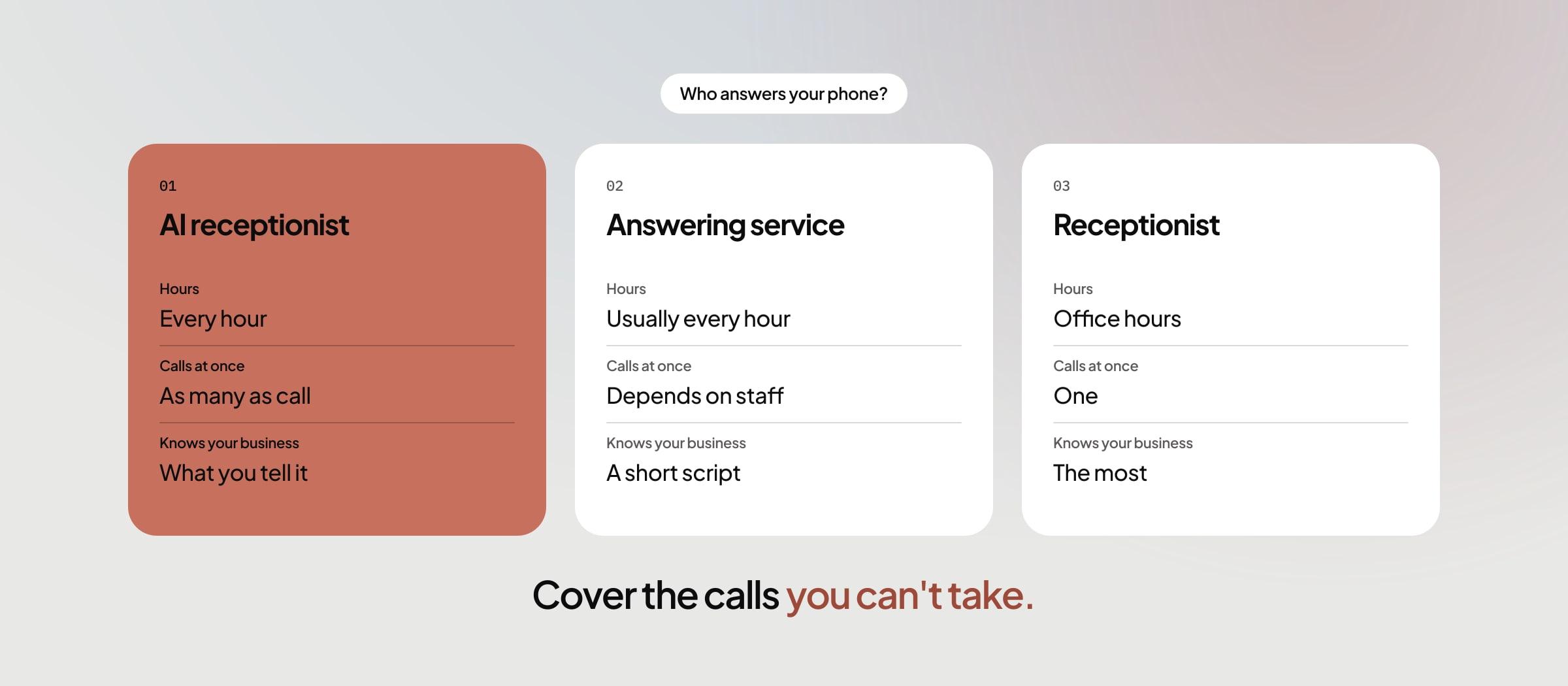
Compare that with the alternative most callers get after hours: a voicemail greeting. An honest AI receptionist that takes the job details is a better experience than a beep.
What should an AI receptionist say at the start of a call?
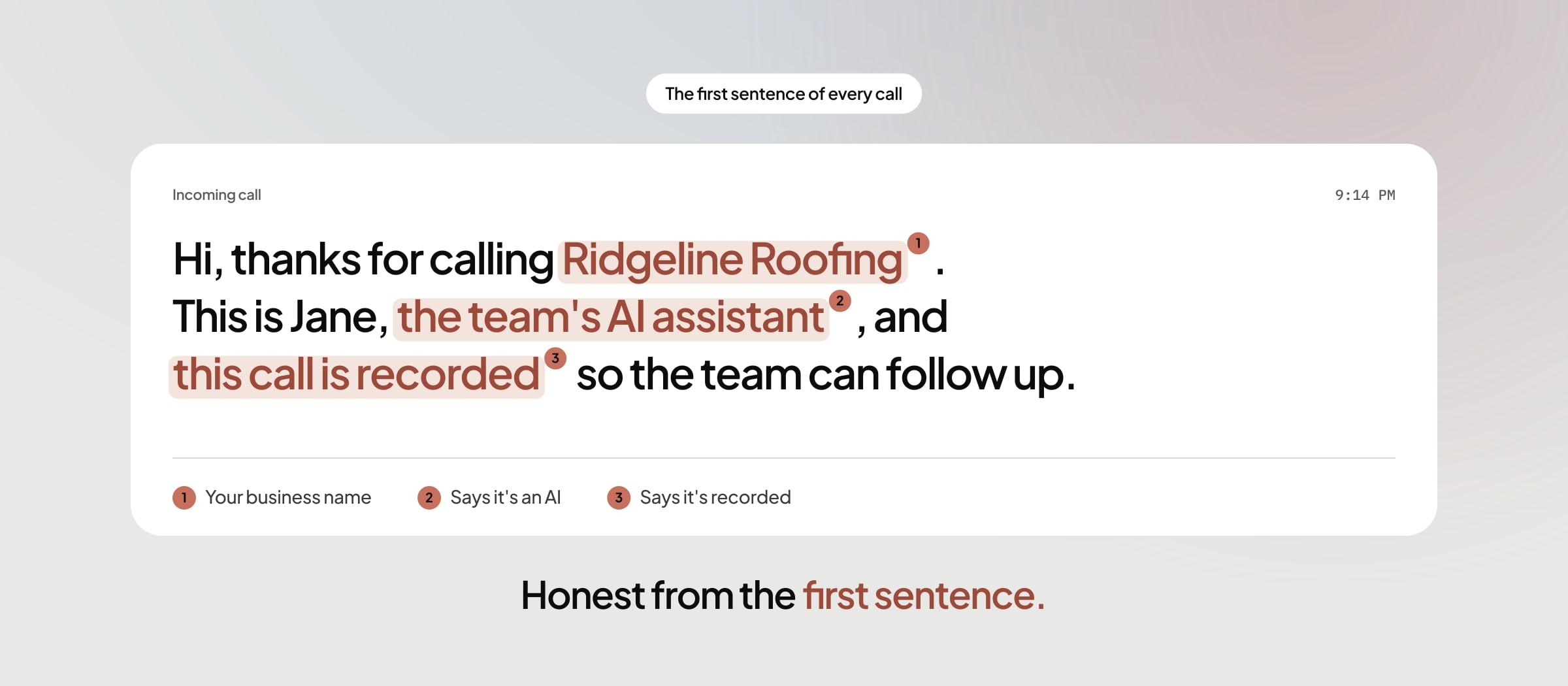
Four things, in one or two sentences: your business name, that it's an AI assistant, that the call is recorded, and an offer to help. For example:
"Hi, thanks for calling Ridgeline Roofing. This is Jane, the team's AI assistant, and just so you know, this call is recorded so the team can follow up. What can I do for you?"
After that, a few rules keep the call honest: never claim to be a person, even if asked twice; never make up prices or promise dates the business hasn't promised; and make it easy to reach a person when the caller needs one.
What happens if a caller asks for a real person?
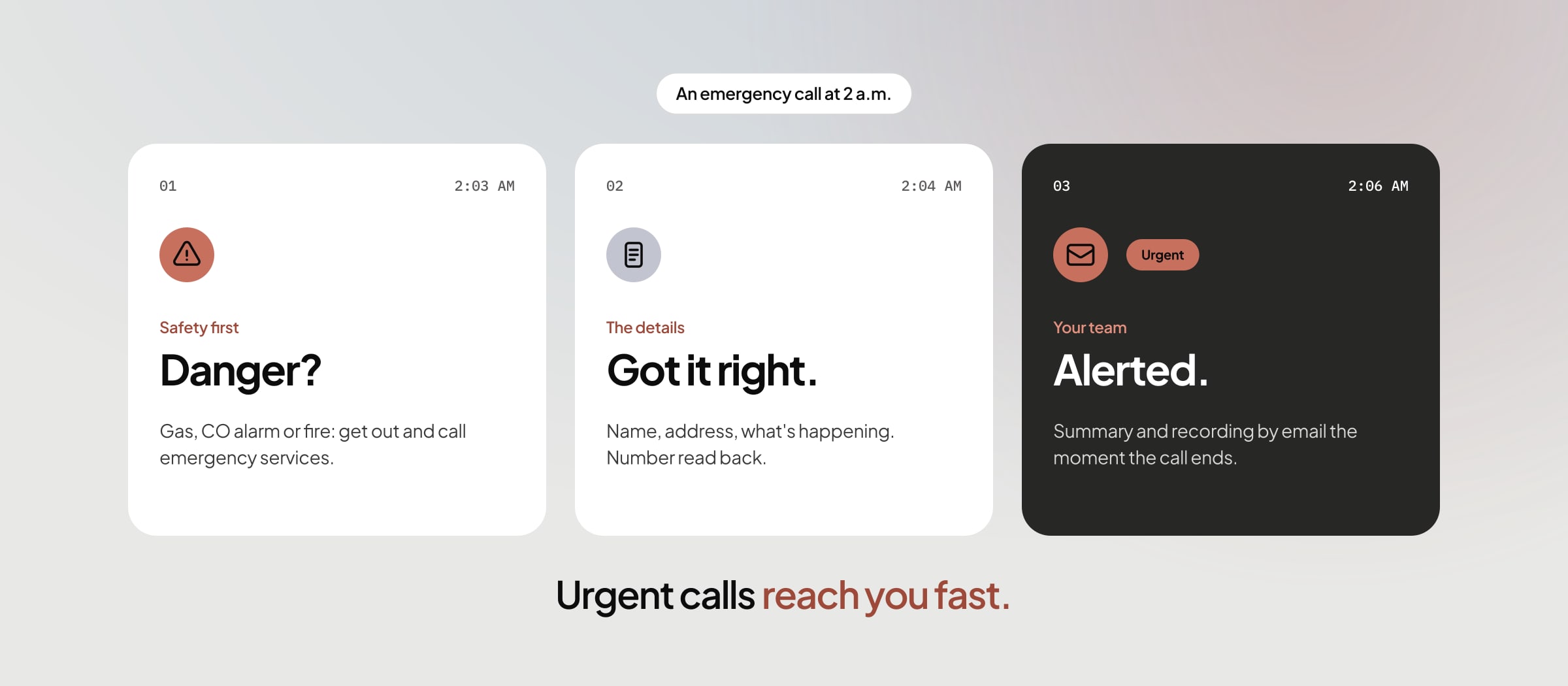
That depends on the service. Some AI receptionists can transfer the call. Jane doesn't put callers through during the call. Instead she takes their name, what they need and a call-back number, tells them a person will call back, and flags the message for your team. Urgent jobs say so in the subject line of the email you get when the call ends, so you can call back fast.
How does an AI receptionist sound?
A good one sounds calm and natural, speaks in short sentences, asks one question at a time and doesn't talk over the caller. It shouldn't sound like a phone menu ("press 1 for...") or read out long paragraphs.
The easiest way to judge is to hear one. Jane answers SiteScan's own phone line, so you can call +1 (320) 441-0075, ask her a question or leave a message, and hear exactly what your customers would.
Frequently asked questions
Do I have to tell callers they're talking to an AI?
It depends on where you and your callers are, and the rules are changing. Utah requires it when a customer asks, the EU AI Act has required it since August 2026, and many states require consent to record calls. Telling every caller at the start that it's an AI and that the call is recorded is the simplest way to cover yourself. This isn't legal advice.
Will customers hang up if they know it's an AI?
Some will, especially people who always want a person. Most callers to a trade business mainly want to be answered and called back quickly. A short, honest greeting, plain questions and a clear promise of a call back keep most callers on the line, and it beats a voicemail beep.
Does an AI receptionist sound like a robot?
Not anymore. Good AI receptionists use natural voices, short sentences and one question at a time, which is why many callers can't tell on their own, and why they should say upfront that they're an AI.
What should an AI receptionist say when it answers?
Your business name, that it's an AI assistant, that the call is recorded, and an offer to help. For example: "Thanks for calling Ridgeline Roofing. This is Jane, the team's AI assistant. This call is recorded so the team can follow up. What can I do for you?"
Can I hear Jane before I decide?
Yes. Jane answers SiteScan's own phone line. Call +1 (320) 441-0075 to hear how she handles a call from the caller's side.